Service Dog Tasks and the Public Access Test, Explained
This page explains the law in general terms. It is not legal advice. For a specific situation, contact the agency listed on this site or an attorney.
Two questions come up again and again when someone starts thinking about a service dog in New Jersey. What tasks can a service dog do, and does the dog have to pass a public access test?
The short answers: a task is specific work that relates directly to a person's disability, and the public access test is a training benchmark, not a legal requirement under the ADA. This guide walks through both, step by step, so you can build a clear training plan and describe your dog's work accurately.
This is general information about the law, not legal advice.
What You Need Before You Start
You do not need to buy special certificates or paperwork. There is no official service dog registry and no certification required under the ADA. Here is what actually helps:
- A written list of your disability-related needs, kept in your own words.
- A dog with a steady temperament, good health and the ability to learn. A veterinarian can discuss health questions with you.
- A well-fitted flat collar or a harness, and a standard leash.
- Small, high-value food rewards, plus a toy if your dog loves one.
- A training log or notebook to record tasks, dates and progress.
- A clicker or marker word, if you use one.
- Access to practice spaces, starting at home and moving to busier places in small steps.
- Optionally, a program or trainer who uses reward-based methods.
Training should follow humane, reward-based methods, in line with the American Veterinary Society of Animal Behavior (AVSAB). Avoid shock, prong or choke collars, alpha rolls, scruffing and dominance methods. They add stress and can damage the working bond between you and your dog.
What Counts as a Service Dog Task?
ADA.gov defines a service animal as a dog that has been individually trained to do work or perform tasks for an individual with a disability. The key phrase is "individually trained." The dog's work has to be taught, and it has to connect to the person's disability.
New Jersey's law is similar. Under the New Jersey Law Against Discrimination, N.J.S.A. 10:5-5(dd), a service dog is a dog individually trained to the requirements of a person with a disability. The definition lists examples such as minimal protection work, rescue work, pulling a wheelchair and retrieving dropped items. It also includes seizure dogs. The New Jersey definition refers to dogs only.
Examples of tasks by type of disability
The examples below follow the kinds of work described in the ADA service animal guidance and the New Jersey definition. Your dog's tasks depend on your own needs, so treat this as a starting point.
| Type of disability | Examples of trained tasks |
|---|---|
| Vision loss | Guiding around obstacles, stopping at curbs and steps |
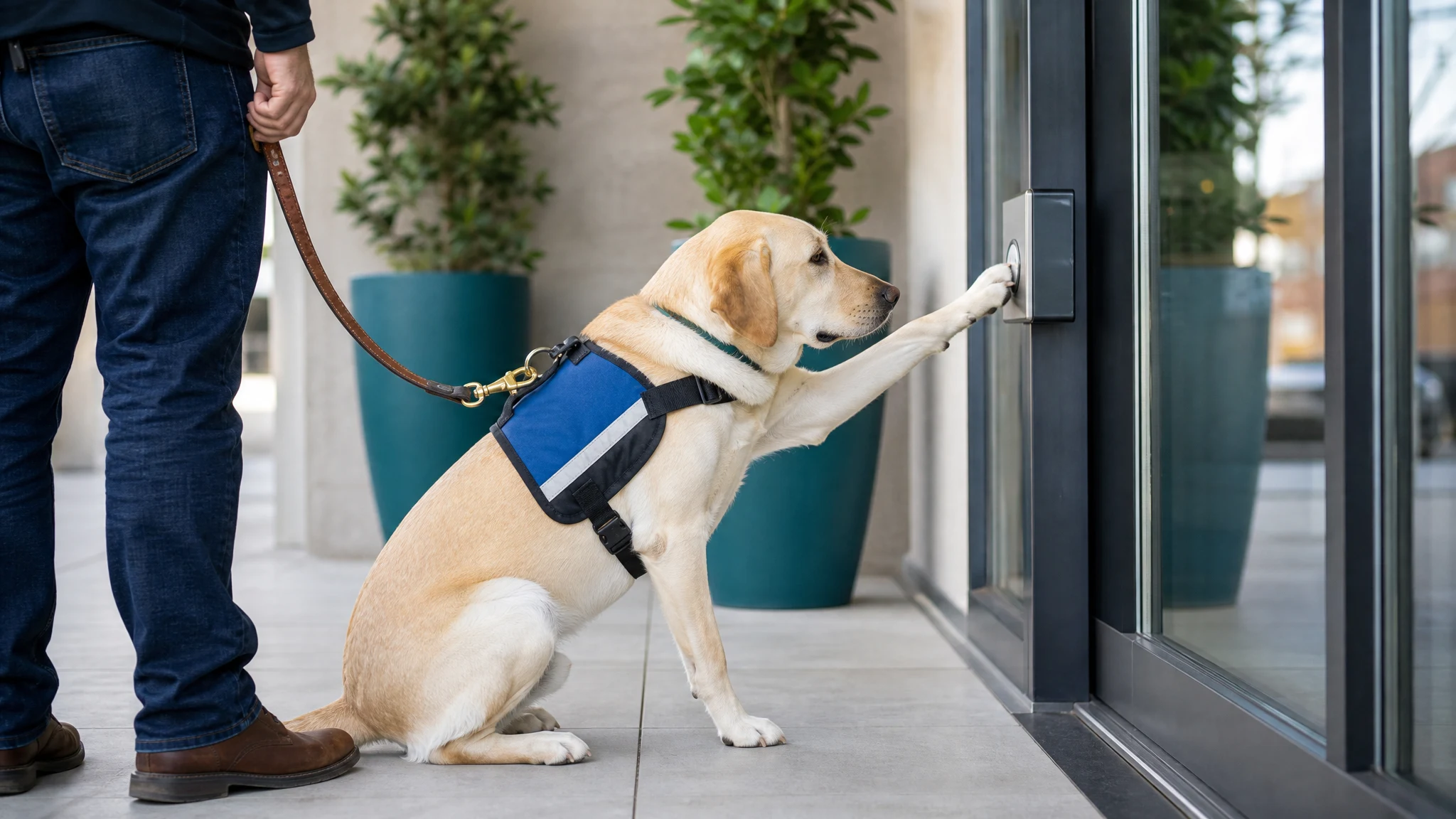
| Mobility disability | Retrieving dropped items, pulling a manual wheelchair, opening doors with a pull strap, bracing for balance |
| Hearing loss | Alerting the handler to specific sounds, such as a smoke alarm or a knock |
| Seizure disorder | Responding to a seizure, for example by getting help or staying in position to protect the handler |
| Diabetes or other medical conditions | Alerting to a change the dog is trained to notice, fetching medication or a phone |
| PTSD or other psychiatric disability | Interrupting a repetitive behavior, turning on lights, creating space in a crowd, reminding the handler to take medication |
Why comfort alone is not a task
Emotional support, therapy and comfort animals are not service animals under the ADA. Having a dog nearby can feel soothing, and that matters to many people. But under ADA.gov guidance, the presence of the dog for comfort is not work or a task.
A trained response is different. If a dog is taught to recognize the early signs of a panic episode and then performs a specific action, such as nudging, applying steady pressure or interrupting the behavior, that is a trained task tied to the disability. The test is whether the dog does something on cue or in response to a trigger, because it was taught to.
Step 1: Name the Tasks Your Disability Requires
Start with your daily life, not with the dog. Write down the moments where a trained response would reduce a barrier. Be specific.
"Helps with anxiety" is too vague. "Interrupts hand-picking when I start, then puts a head on my knee until I give a release cue" is a task you can actually train.
For each item, write three things: the trigger, the dog's action and the end signal. This turns a general need into a trainable behavior.
Step 2: Build Foundation Skills First
Tasks sit on top of basic manners. Before adding task work, teach the dog to:
- Sit, down and stay, with a release cue.
- Walk on a loose leash.
- Come when called.
- Settle quietly under a table or beside a chair.
- Leave food and dropped items alone on cue.
- Tolerate handling, grooming and a vet exam calmly.
Short sessions of five to ten minutes usually work better than long ones. End on a success, and keep rewards frequent while the dog is learning.
Step 3: Teach Each Task in Small Pieces
Break every task into tiny steps and reward each one. For a retrieve, for example, you might reward looking at the item, then touching it, then picking it up, then holding it, then bringing it to your hand.
- Teach the behavior in a quiet room with no distractions.
- Add a cue or a trigger once the behavior is reliable.
- Change one thing at a time: distance, duration or distraction, never all three at once.
- Practice in different rooms, then outdoors, then in calm public places.
For alert tasks, such as responding to a sound or a physical sign, work with a trainer who uses reward-based methods. These tasks are harder to shape alone, and results can vary a lot from dog to dog.
Step 4: Understand What the Public Access Test Is
A service dog public access test is a structured check of how a dog behaves in public. Assistance Dogs International (ADI), the accreditation body for many assistance dog programs, uses a public access standard that its member programs apply. Canine Companions, for example, states on its own website that ADI is its accreditation body.
It is important to be exact here. The public access test is a training benchmark. It is not a legal requirement under the ADA, and the ADA does not require any test, certificate or ID. A dog is not legally a service animal because it passed a test, and it does not lose that status because you never took one.
So why use it? Because it gives you a clear, objective way to measure whether your dog is ready for busy places. Many handlers find it a useful checklist. For the current test items and scoring, check with ADI or with an ADI-accredited program, since the details can change and this article does not reproduce them.
Step 5: Practice Public Access Skills in Stages
Whether or not you ever take a formal test, the areas it generally checks are the same ones that matter in real life. Build them gradually:
- Calm entry and exit. The dog waits at doors and moves through without pulling.
- Loose-leash walking past other people, carts and other dogs.
- Settling quietly during a meal, a meeting or a wait.
- Ignoring distractions such as dropped food, friendly strangers and sudden noises.
- Staying under control in elevators, narrow aisles and crowded spaces.
- Appropriate toileting only on cue and in a suitable spot.
- Staying with you when you step away briefly, if that fits your needs.
Start in quiet places and increase difficulty only when the dog is relaxed, taking food and responding to cues. If the dog seems stressed, go back a step. A dog that is not comfortable in public should not be pushed, and some dogs are better suited to other roles.
Step 6: Know the Rules That Apply in New Jersey
Under the New Jersey Law Against Discrimination, a person with a disability accompanied by a service or guide dog has full and equal access to public facilities. Two conditions apply: you must keep the dog in your immediate custody at all times, and you may not be charged any extra fee for admission to or use of the facility. The same law covers employment (N.J.S.A. 10:5-29.1) and housing accommodations (N.J.S.A. 10:5-29.2). For the exact exceptions in the housing section, read the full text on njleg.gov.
When a dog's role is not obvious, ADA.gov says staff may ask only two questions. First, is the dog a service animal required because of a disability? Second, what work or task has the dog been trained to perform? Staff cannot demand paperwork, a demonstration or details about your condition. Having your tasks clearly in mind, as you wrote them in Step 1, makes the second question easy to answer in a sentence.
Dogs in training are treated differently. Under N.J.S.A. 10:5-29.3 as currently in force, only a service or guide dog trainer actively engaged in training has the same access rights as a person with a disability, and under 10:5-5(t) a trainer is employed by an organization generally recognized by rehabilitation agencies. Volunteer puppy raisers are not covered. A pending bill, S573 in the 2026-2027 session, would extend access to more people engaged in training, with conditions. As of the version reviewed, it had only been introduced and is not law. Check the NJ Legislature for its current status.
For a broader look at access rights, see service dogs in New Jersey: training, access rights and where to go.
Tips for Better Training
- Keep a log. Notes on each task, with dates, help you see progress and describe your dog's work clearly.
- Reward generously early on, then thin out food rewards gradually.
- Train in short bursts and end before your dog is tired.
- Practice when you are relaxed. Dogs read your mood.
- Give your dog regular off-duty time to play, sniff and be a dog.
- If you want outside help, ask any trainer or program about their methods and make sure they are reward-based.
- Check with each program directly about eligibility, cost and wait times. For example, The Seeing Eye in Morristown trains guide dogs, Semper Fido in Marlton serves veterans and Operation K9 Beethoven in Paramus provides psychiatric service dogs to veterans. Cost and availability can change, so confirm with each organization.
Common Mistakes to Avoid
- Counting comfort as a task. A dog that simply makes you feel better is valued, but it does not meet the ADA definition on that basis alone.
- Buying a registration or ID. There is no official registry or required certification under the ADA. An online certificate is not legal proof, so do not rely on one.
- Skipping the foundations. Task work falls apart when the dog cannot settle or walk calmly.
- Rushing into crowds. Too much too soon can create fear or reactivity that is hard to undo.
- Using harsh tools or corrections. Shock, prong and choke collars and dominance methods go against AVSAB guidance and can harm the dog's confidence.
- Treating the public access test as a legal pass or fail. It is a benchmark for your own readiness, not a license.
- Dressing a dog to look like a guide dog. New Jersey penalizes fitting a dog with a harness of the type commonly used by blind persons to represent it as a guide dog, and intentionally interfering with a disabled person's rights or a dog's function. N.J.S.A. 10:5-29.5 sets a fine of $100 to $500. Check njleg.gov for the exact scope of that section.
What Results to Expect
Every dog and handler pair is different, so timelines vary. Many handlers find that training reliable tasks and public manners takes many months of steady practice, and often longer. Some dogs may not be suited to the work, and that is a normal part of the process.
With patient, reward-based training, you may find that your dog responds to cues more consistently, stays calmer in public and performs its tasks more dependably over time. Progress is rarely a straight line. Setbacks around new places and distractions are common and usually improve with more practice.
If a business denies access, New Jersey law sets civil penalties for interfering with or denying access under N.J.S.A. 10:5-29.11(a): $250 for a first violation, rising to up to $1,000 for the third and each later violation. The reader should check with the appropriate New Jersey agency or an attorney about how to file a complaint, since this article does not list a specific complaint office.
Quick Recap
- Identify the tasks your disability requires.
- Build foundation skills first.
- Teach each task in small, rewarded steps.
- Understand that the public access test is a benchmark, not a legal rule.
- Practice public skills in stages.
- Know your rights and responsibilities under New Jersey and federal law.